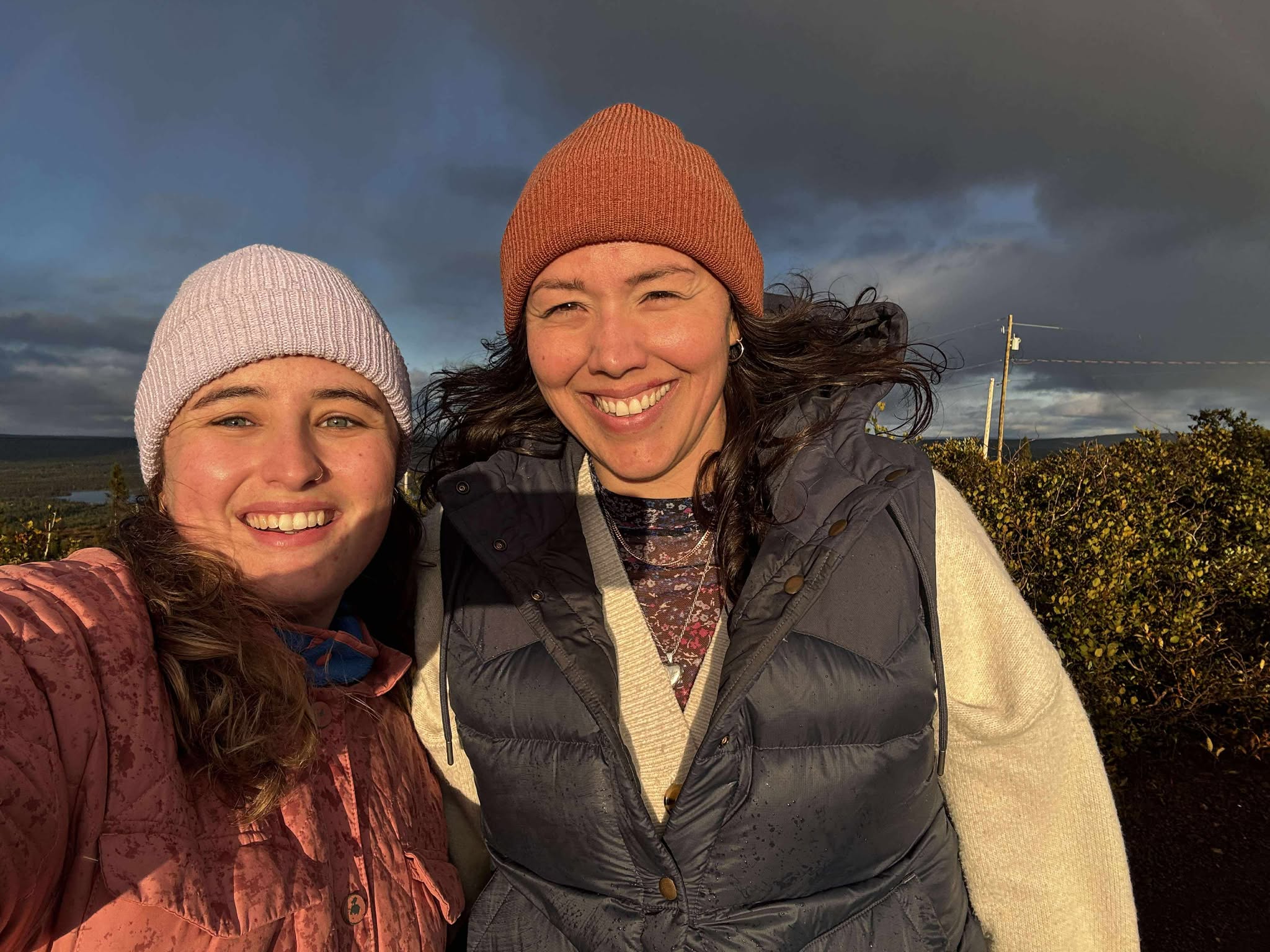
In the spring of 2025, we were approached to offer a doula training in Northern Quebec. In Matimekush. Thousands of kilometers from home.
Our first reaction was to ask ourselves: why us? Two white women, with no real understanding of the Indigenous experience. When we realized that no Indigenous doula could offer this training, we decided to take the plunge — making it clear that we could not cover the cultural portion of the training.
We worked hard to develop a program that could equip two doulas from the community. In our research, we discovered that women had to travel all the way to Sept-Îles to give birth. Schefferville’s hospital had been demolished at the same time the mining companies left in the 1980s. Since then, pregnant women must fly at 36 weeks gestation to give birth far from home and family, often alone.
During the training, the students spoke to us repeatedly about the time when their mothers and grandmothers could give birth in the community. Today, it is very different: they are displaced 700 km from home, leaving their other children behind, to give birth with strangers, far from their traditions. You can imagine the number of inductions, interventions, and obstetric violence these women face.
We had tried to imagine what awaited us in this training and thought we knew a little about the reality of Indigenous communities in Canada. But the cultural shock was immense. It’s impossible to fully understand in five days, yet several things left a lasting impression.
First, the insularity of the Matimekush community is striking. I could never have imagined the feeling of being “trapped” in such a place. There are very few ways in or out. An insularity within Quebec itself. You can only leave by plane or train. While most people can drive to Walmart, there you must fly.
Next, the segregation between Indigenous and non-Indigenous people was striking. We had expected it, but the division is very clear. Non-Indigenous people are mainly present to provide services (healthcare, education) to the community or to extract the territory’s resources. We thought we would find a rich ancestral culture in Matimekush. While we had the immense privilege of learning more from the students, we were left with an uneasy feeling: a strong sense of the impacts of colonialism and cultural genocide. Feeling like we were encountering people whose culture had been taken from them and replaced by imposed dogmas that persist to this day.
Another reality that struck us was the cost of living. Everything is astronomically more expensive: a simple grocery basket costs two to three times what we pay in the south, a tank of gas is a luxury, and basic products, when available, are sold at unimaginable prices. For families already strained by remoteness and structural inequalities, this represents a tremendous burden.
It is thinking of these women, these mothers, these families that we are launching a collection of feminine hygiene and postpartum products today. Because no one should have to choose between buying milk for their children or sanitary products. Because dignity and well-being should not depend on a postal code.
Beyond the products themselves, our goal is also to support the start of a support program led by two outstanding doulas from the community. Providing them with the necessary resources allows them to offer presence, listening, and culturally sensitive support directly within their community.
Our time in Matimekush opened our eyes, and more importantly, our hearts. If we cannot change everything, we can at least take concrete actions of solidarity. And together, these actions matter.
Link to our campaign